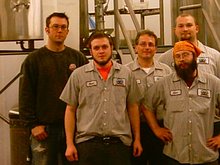
One of the most impressive sights at a production brewery is the automated bottling line running at a good pace. Even small bottling operations are pretty cool to watch, like our previous setup back at Fairbanks which consisted of a 24-head filler, a labeler, a case packer, and a six-pack erector. Pretty much everything else there was done manually; at the front end of the line we had a couple of "volunteers", usually Hope College students, snatching empty bottles off of pallets and loading them onto the conveyor as fast as they could. Some of these volunteers were real characters, but that's another story for another 'blog entry. For the back end of the line we stitched case "mother" boxes a few days ahead of time, then stuffed six-pack holders into them during the run and fed them onto the case packer conveyor to have the bottles dropped in. Ideally there was actually a case in position under the bottles when they dropped out of the packer, since 24 smashed bottles and their previously contained beer took some time to clean up and would stop the whole process (hopefully before bladders were about to burst so the rest of us could bolt for the can). The cases that were successfully packed with bottles were hand-taped shut, the date was stamped on the top, and they were then stacked on pallets. Most days the whole process seemed like barely controlled mayhem but one way or another we usually made it happen. Anyway, we really thought we were the shit, running about 800-1200 cases during most bottling runs. The "record" for a day was around 1300: a LONG day on that line.
When things went well it was a pretty good day: volunteers keeping the line supplied with bottles, beer filling nicely, labels straight and staying put (right side up, always a nice touch), and so on. But fairly often one machine or another would take us on a demon hell-ride and make us wonder why we'd ever been born. The filler in particular had a habit of wreaking havoc, and woe to the poor bugger who was running it that day. You knew it was going to be a long one when a string of shitpissgoddamnwhorebitch's came flying out from the corner where the filler lived, usually followed by a thrown bottle or three. One day a tall stack of short-filled bottles in cases "accidentally" tipped over, gently nudged by Uncle Frustration. Good times.
So when we found out that part of our move to 690 included a "new" bottling line with almost everything automated, we started counting the days 'til the last run on the "old" line. You'll notice that "old" and "new" are in quotations; well, in this case old and new are only relative as to when we owned the equipment, not actual age. We were impressed when we learned that our "new" Cemco filler would have 60 heads compared to the 24 on our "old" Cortellazzi, but our "new" filler is 20-some years older. Not necessarily a bad thing though: the "new" Cemco is a much simpler machine and built like a freakin' tank (and the shop manual is in English, not Italian). And as Himself assured us: "Back in the day this was the Rolls Royce of fillers, ALL the big operations had 'em." COOL! (we think). A lot of this equipment has lived at some pretty big breweries over the years, and we still find the occasional Rolling Rock or Sierra Nevada bottle cap or piece of glass hiding in a machine.
With progress comes change: gone are our hungover bottle-feeding volunteers. That job is now done by one brewer on the depalletizer. The full pallets of bottles are put in position and a rake pushes the bottles onto the front end of the line. They're run through the rinser and over to the filler, then the labeler, and finally the case packer. Where we previously had to erect and stitch case boxes a few days ahead of time, there's now a big green beast of a machine that takes the flat cardboard boxes, pops them open, and glues the bottoms closed automatically. A six-pack erector still pops open the flat six-packs, but the new one is faster and shoots them onto a conveyor instead of into a lucky brewer's lap to be stuffed into the case boxes. The stuffing is now done by another machine further down the line, and the stuffed cases are then fed to the case packer. After the bottles are dropped in the case tops are automatically closed and glued, the production code printed on the side, and then spit out onto a conveyor where one of us has to manually stack them onto pallets. A serpentine string of conveyors hooks all of this together, and when it's all working as it should the only thing done with muscle is keeping the case and six-pack machines full of paper and the stacking of cases at the end. We run the line at about 150 bottles per minute, which translates to a case coming off the end of the line every 10 seconds. This is dead slow for this bottling line: it can easily run at twice that pace, and the filler can run up to 600 bottles per minute, or a case every four seconds.
Of course that's all in the perfect world that exists only in our dreams; reality has a funny way of being, well, reality, and bottling days are still our least favorite day of the week. Cardboard gets crunched instead of popped open. Bottles like to drop off of the pallets as they're being positioned. Caps get stuck in the crowner which sets off a loud horn reminiscent of an elementary school fire drill. Labels indiscriminately decide to stick to everything but the bottles. The case packer occasionally performs its classic bottle-drop-into-no-case routine. Any slight misadjustment to any of the machinery can cause one (or more) of the above. And with some of the equipment being 45 years old, things tend to slip out of adjustment on a regular basis. During our first several runs the learning curve was steep and we were running from one machine to the next trying to figure out what in the hell was going on, usually in more than one place at once ("Hey, I need your help over here"..."No, I need YOUR help over HERE"). A bit of blood flowed but nothing that some duct tape and Band-Aids wouldn't fix. We also learned that "Machine Can Start At Any Time" labels are worth noting and that an arm pressed to about half it's thickness is only interesting if it's not attached to your body...we needed a bigger Band-Aid, painkillers and professional assistance for that one. As the months went by things began to settle down though, as we figured out that turning that big bolt just a wee bit would set things right again on the case stuffer, that the glue pumps work better with just a bit more air pressure, and that Vise-Grips clipped in just the right spot would keep bottles from crashing to the floor. Referring to the machinery manuals (if we had one) could be both frustrating and enlightening: sometimes the machine had been modified so much by a previous owner that the manual was useless, yet we also learned where critical parts had been removed and needed to be reinstalled to fix an issue.
So bottling days are slowly becoming tolerable, we're getting more beer into bottles and less on the floor, and we're starting to think that we're the shit again. The new run "record" is a little over 2,000 cases (a cakewalk), and a thousand case run is looked at with disdain. Drink up, people...we're almost ready to shift the beast out of first gear.
Thursday, April 26, 2007

Wednesday, April 11, 2007
The Joy of Homebrewing
Ah Spring is coming here at 690. It’s currently snowing outside but spring will soon be here. The birds are singing, the grass is turning green and the brewers at New Holland are cleaning out the kegerator and pacing out the horseshoe pits in the snow. With the kegerator up and running we have been doing a lot of homebrewing on the pilot system. What could make someone who brews all day want to stay after and fire up a five gallon batch. Well for one, we get to brew all the crazy shit that a group of thirsty brewers can think up. Most planning consists of “Let’s make something big”, “No let’s see how much hops we can put in”, “It should be dark” and “how about something light and refreshing for summer”. After a round of laughter and wiping our eyes at the thought of making something light and refreshing we fire the system up. With the different types of yeast we have going now we can brew almost anything we can think of. Our last project was making fifteen gallons of beer and splitting it into three five gallon batches with different yeast in each batch. We even spiked some with some sour stuff from our friend Frank. The joys of homebrewing for me is getting a better understanding of the effect of each of the different type of yeasts and grain we use, learning how to formulate recipes and lets not forget the joy of being able to drink a beer I’ve made without having to pay for it. Yes spring is coming and soon the tulips will be out. I’d better get to homebrewing. Maybe I’ll brew a porter or a hoppy pale ale. A stout sounds pretty good too, I think I’ll go fire up the system.
Thursday, March 29, 2007
The Frank Debate
Well, believe it or not, the brewers at New Holland Brewing Company now have their own blog. I suppose I should begin by attempting to explain some sort of purpose behind all of this, if there is one. The goal is to leave one member of the production crew in charge of posting to this blog each week. This should allow for a variety of different viewpoints, topics, and beer fueled mayhem as we see fit. So to kick it all off, let's talk about Frank. First of all, Frank is the working title of a sour beer experiment that we've been playing with. Being a fan of just about every sour beer I've been able to get my grubby little paws on, I'm personally pretty pumped about it. For a moment let's forget about what this beer tastes like or is named and get to a little debate floating through the brewery: to keg or to bottle? On one side, there is a viewpoint that we should bottle all of this beer into 750ml bombers and be done with it. The other opinion is to take a keg or two and release this beast upon the unsuspecting Holland public at our pub. I say both - not because I want people to experience something they may not otherwise try (which I do), not so the company can make more money, but simply so I can sit down in our pub and have a pint of this amazing shit. That's it, that's my big argument. I want to be able to drink this beer that has been in the works for about a year now, this beer that has made the trek from Fairbanks to Commerce Ct., after tastings, blendings, and weeks of trying to carbonate this son of a bitch, I want a pint. Now a bit on why we call this beer Frank, even though I know that this name will get shot down just like every other beer name we come up with - once it hits the shelf it will probably either be called some p.c. name that doesn't mean a damn thing or some random ancient Greek name nobody can pronounce. Here lies my argument for Frank: we had a friend of ours come through the brewery not too long ago, who just so happens to work for a large craft brewery in the region. He brought us a little of his sour beer project that he was proud of (and rightfully so) and after tasting it, we offered up a sample of our little experiment. He didn't seem the least bit interested, so after he left we drank the two side-by-side and came to the conclusion that ours was just a little bit more "out there" for lack of a better description. Needless to say, we at the production crew have un-officially named the beer in his name - almost like throwing down the gauntlet, slapping him in the face with our collective glove, and challenging him to a sour beer duel. Hopefully we can slip through the cracks with the name Frank, but we'll just have to wait and see what the powers that be come up with. Regardless of the name, or how it is served (draft or bottle), we're proud of the beer, which is what matters to us at the end of the day. Until next time.....
Subscribe to:
Posts (Atom)